The Catalyst
December 2025
The established multilateral trading order anchored by the WTO is breaking down, and global supply chains are being reconfigured even as India faces among the most extreme tariffs imposed globally by the Trump administration. Historically, however, it is precisely at such crunch times that India has reformed.
Ashish Dhawan,
Founder-CEO, The Convergence Foundation
Ashish Dhawan,
Founder-CEO, The Convergence Foundation
As the year turns, we are ringing out the old and ringing in the new at a time of great tumult. The established multilateral trading order anchored by the WTO is breaking down, and global supply chains are being reconfigured even as India faces among the most extreme tariffs imposed globally by the Trump administration. Historically, however, it is precisely at such crunch times that India has reformed, setting the stage for enhanced economic performance going forward. The Convergence Foundation's (TCF) portfolio is working on some key reform ideas that have the potential of propelling India to developed status by 2047. Here are eight big agenda items that we believe deserve to be taken up in mission mode in 2026.
First, we need an ambitious National Manufacturing Mission that integrates with global value chains and prioritises jobs, leveraging India’s advantages in low-cost labour. For this, we need to unlock exports in labour-intensive sectors. Adapting the template that was used to draw in Apple to produce iPhones in India for export, India should attract 50 marquee brands across labour-intensive sectors such as apparel, footwear, furniture, toys, tools, machinery, and electronics – a strategy that will ramp up high-quality manufacturing, growth, and jobs.
85% of brain development occurs before the age of six, and those born today will be entering the labour force circa 2047. To ensure that India has the human capital of a developed nation, it is as necessary today to build out its ‘soft’ infrastructure in the form of nurseries, creches, and schools that impart foundational literacy and numeracy (FLN) by the time children reach Class 3, as it is to boost ‘hard’ infrastructure such as highways and ports.

85%
Of brain development occurs before the age of 6
Skilling is important, so that young people graduating from schools and colleges have the kind of competencies that a 21st century workforce demands. Apprenticeships should be made aspirational and linked to degrees as well as to growth sectors in industry. Embedding apprenticeships in college degree programs is an idea that is already being experimented with and should be expanded upon.
Overseas employment can be a key growth sector – India already earns more from remittances than it does from any single category of merchandise exports. Affluent nations will need an additional 400 million workers to sustain their economies over the next 30 years. To leverage its demographic dividend, India needs to position itself as a global talent hub.
10%
Of global GDP is contributed by tourism
One sector that can rev up growth irrespective of external tariffs is tourism. Tourism contributes 10% of global GDP and is a job spinner to boot – but India attracts only 1.4% of global tourist arrivals. To vault to its true potential, India should aim for a tourism sector worth $500 billion by 2035, generating 65 million direct jobs (up from $200 billion currently, generating 30 million jobs).
India is a fount of STEM talent. To attain sovereign capability in critical technologies, capture a higher share of value as it participates in global value chains, and escape the “middle income trap”, India must step up its level of innovation, research, and development. This has to be a mission where government, industry, and higher educational institutions join forces and each does its bit, while the Trump administration's cutting back on science funding and high-skill immigration is leveraged to lure back trained scientists and high-skill talent – all of which can go towards crafting a thriving knowledge economy at home.

1.4%
Of global tourist arrivals come to India
While the most important roles in realising the above missions will naturally belong to the government, they will need an industry and a whole-of-society effort that involves non-profits as well. Over the last decade, India has experienced one of the fastest surges in wealth creation globally. While that should translate into more donations for social good, such philanthropic investments also need to be guided into high-yield, high-impact systemic giving that can play a catalytic role in realising a prosperous India.
Finally, cutting across many of the sectors above, curbing regulatory cholesterol is of paramount importance. The licence raj was dismantled in 1991, the inspector raj needs to go. Realising the need for this, the government has set up a high-level committee for regulatory reform, expected to make recommendations that turn India’s regulatory framework from clunky and punitive to light-touch. It is very important to make this shift happen, so that the prevailing attitude of regulators towards enterprise transforms from one of distrust to trust.
As we journey towards 2047, this should offer a comprehensive list of to-do items for 2026!

This quarter, TCF expanded its network by incubating SCALE and STEP Foundation and partnering with DAKSH.
SCALE is working to build a platform for actors working towards systemic change. It will guide funders (CSRs and philanthropists) to identify high-impact investable opportunities, support SSOs by enabling their capacity to design systemic programmes, and help governments apply systems thinking to their policy priorities. STEP Foundation (Skilling, Training & Employability for Prosperity) aims to strengthen India’s skilling and employability ecosystem by addressing structural and systemic gaps. DAKSH is a non-profit think tank working on the Rule of Law by improving the functioning of courts and tribunals. It leverages perspectives from data, technology, processes, institutional ecosystem, and administration.
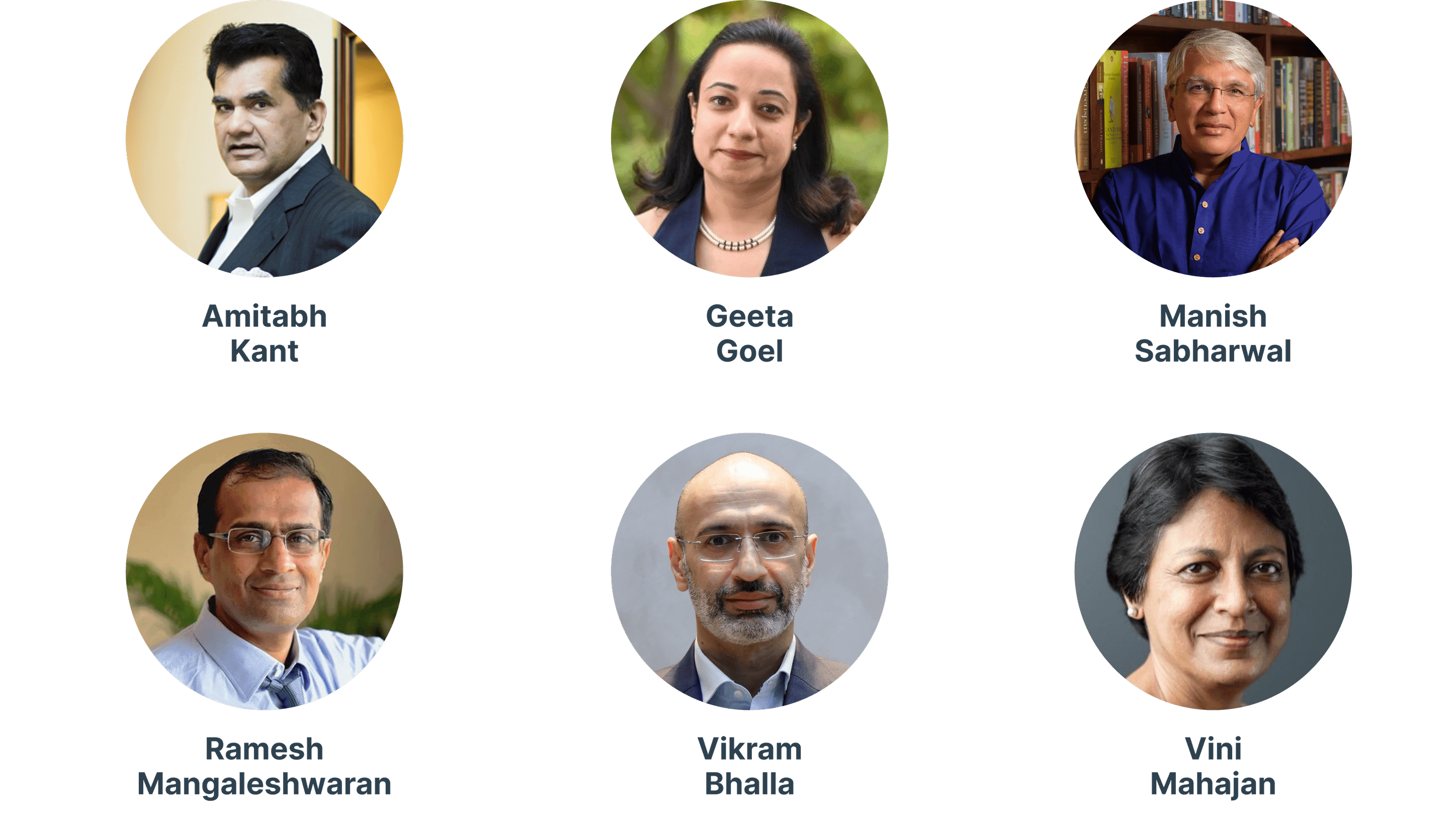
TCF's Advisory Board now includes: Amitabh Kant, former G20 Sherpa of India and former CEO of NITI Aayog; Geeta Goel, former Head of Global Growth Initiatives and former Managing Director of the India office at Michael & Susan Dell Foundation; Manish Sabharwal, Vice Chairman of TeamLease Services; Ramesh Mangaleswaran, Senior Partner Emeritus at McKinsey & Company; Vikram Bhalla, Senior Partner and Managing Director at Boston Consulting Group’s Mumbai office; and Vini Mahajan, former Secretary, Department of Drinking Water and Sanitation, Ministry of Jal Shakti, and a retired IAS officer of the 1987 Punjab cadre. Explore the full list of Advisory Board members here.

Highlights from our Network

Over the last quarter, Rocket Learning advanced early childhood priorities in India and globally. It facilitated the Ministry of Women and Child Development’s participation at a UN General Assembly dinner hosted by TheirWorld and UNICEF, and partnered on the ‘Act for Early Years’ campaign for the 2027 International Financing Summit. Nationally, marking 50 years of the Anganwadi system, Rocket Learning supported the rollout of ‘Vidyarambh’ certificates recognising early education at Anganwadis. It also helped the Ministry position Early Childhood Care and Education as a sub-theme for ‘Viksit Bh ...
India’s Translational Research Initiative (ITRI) has committed ₹30 crore to launch the Mumbai Biocluster at the Institute of Chemical Technology, Mumbai. This eight-storey translational biopharma hub will feature GMP-compliant biologics pilot manufacturing, synthetic biology labs, rare-disease research, AI-driven drug discovery, and workforce training facilities. By providing shared scientific infrastructure and scale-up capacity, ITRI aims to transform early-stage research into globally competitive therapies, acting as a system builder bridging discovery and delivery. The initiative establish ...

In September, Atithi Foundation signed an MoU with Incredible India, Ministry of Tourism, to provide strategic support on India’s tourism agenda. Under the MoU, Atithi will help design, operationalise, and pilot destination management organisations while strengthening ease of doing business for tourism investors across key states. The partnership will combine rigorous research, policy design, and on-ground implementation to address sector bottlenecks and unlock new opportunities. By focusing on improving investor experience, enhancing destination governance, and enabling coordinated delivery, ...
Nearly two years after Foundation for Economic Development’s (FED) report with NITI Aayog on boosting MSME exports, two key reform recommendations have been implemented by the RBI. Exporters no longer need to match every invoice to each payment; reconciliation can now be done quarterly, significantly reducing compliance burden. The RBI has also removed the 25% cap on discounts and mark-ups for forward-deployed inventory, allowing exporters to self-certify without restriction. These changes address major pain points for smaller e-commerce exporters and ease operations for larger firms, showcasi ...
Global Access to Talent from India (GATI) Foundation has signed an MoU with the Department of Skill Development and Technical Education, Government of Odisha, to accelerate overseas employment pathways for youth. Building on its successful model in Maharashtra, GATI will establish Odisha’s first Global Skills Mobility Unit at the World Skills Center, Bhubaneswar, creating structured pathways for global opportunities and supporting the government’s Viksit Odisha 2036 goals. In Maharashtra, GATI’s technical partnership with the International Placement Cell has already made significant progress. ...

The Udaiti Foundation’s (TUF) systems work has advanced significantly at national and state levels. At the Centre, two major partnerships are now operational: a Technical Support Unit within the Ministry of Labour and Employment (MoLE) to drive India’s FLFPR 70% by 2047 goal, and a PMU within the Ministry of Women & Child Development (MoWCD) to redesign the Sakhi Niwas scheme into a scalable women’s housing model. Weekly co-creation sessions with MoWCD are shaping affordable housing for urban service-sector workers, while MoLE is executing a five-pathway logframe. In Uttar Pradesh, the CM- ...








Translational Research is the process of transforming basic research knowledge and innovations into real-world applications. Commercialising research to increase the availability of innovative products in the market is critical for driving economic growth and improving productivity.

In the heart of Amla Noabad village in Madhya Pradesh, Government Primary School Bawdiya shines as a symbol of educational transformation. Devnarayan Verma, the teacher of this school, has a deep heartfelt relationship with the children. His passion for teaching and his commitment to making learning an enjoyable experience has not only left an indelible mark on his students, but has also become a source of inspiration for educators across the region. Read the full story here.


The Convergence Foundation seeks to be a powerful catalyst in India’s development journey, by creating momentum around pivotal ideas that have the highest potential for transformational change.
©2024-25 The Convergence Foundation
T&C | Privacy Policy
Designed with 🤍 by Sane Difference & Urbanhub Innovations